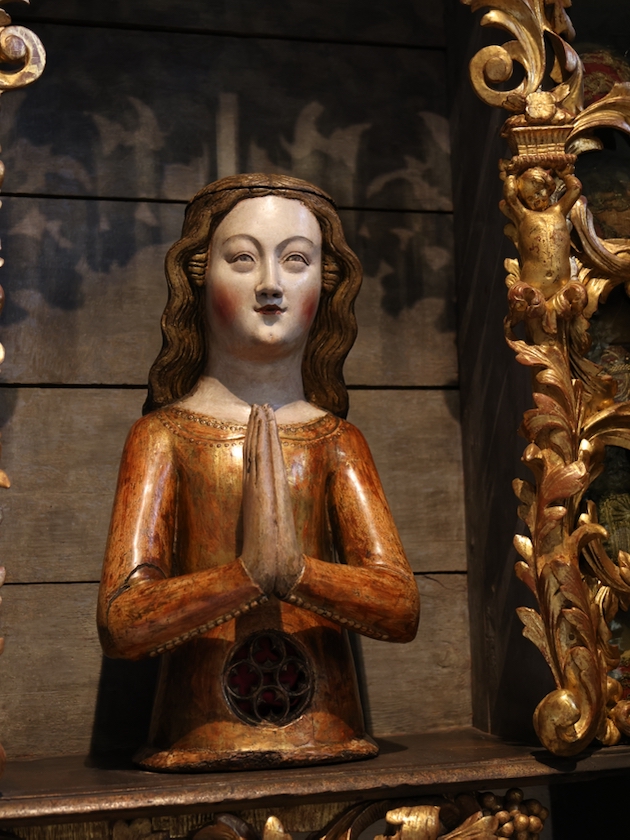
(Above) Bernini’s grandiose tomb of Pope Alexander VII in St. Peter’s, Rome (1670-77). The image of the praying pontiff is surrounded by representations of the virtues and attributes that should characterize a pope: charity, truth, justice and prudence. Reaching up from below is death brandishing his hourglass – a stark reminder of reality.
- Pope Leo XIV
After more than eight months, a degree of clarity has emerged regarding the personality and intentions of Pope Leo XIV.
In terms of style, Pope Leo breaks with his predecessor in many respects. Instead of Pope Francis’s confrontational, vindictive personality, Pope Leo has striven to project an image of calm and serenity. Instead of dictatorial centralization of all authority in the pope, Leo has at least held out the possibility of a more consultative style of leadership. Leo’s discourse also frequently reverts to traditional Catholic concepts. Pope Leo has reached out to those who, under Francis, had been marginalized or worse. Selected elements of papal and liturgical tradition have been restored – for example, the announced return of the pope to the Vatican apartments. Some administrative measures of Pope Francis have been reversed and some of that pope’s lower-level enforcers have been reassigned.
Yet, the elements of continuity with the prior pontificate are even stronger. Leo has retained in office almost all the main figures of the era of Pope Francis. Men such as Fernandez, Roche and Parolin continue to assert their progressive theological, liturgical, and political ideas as before. The pope’s first encyclical was dominated by the thought of Francis. The pope’s first consistory was guided by leading associates of Pope Francis. The pope‘s own rhetoric at times can be distinctly Bergoglian in character. The same can be said of the style of his media interactions. The pope’s appointments to episcopal and Vatican positions have been reliably center-left or left.
Thus, two tendencies coexist in the early pontificate of Leo: (a) a desire for unity within the Church, involving more or less subtle abandonment or adjustment of aspects of his predecessor’s leadership style; and (b) a commitment to the substantive elements of the papacy of Pope Francis. Yet Leo is not necessarily merely repackaging of the pontificate of Pope Francis – continuing the Bergoglian administration, but in a kinder, gentler way. Pope Francis was not just a “dictator pope,” but an almost fanatical ideologue as well. His leadership style reflected the substance of his beliefs. With Pope Leo, there is a disconnect between much of the outer form (which a friend of mine characterized as “Ratzingerian”) and the continuing Bergoglian content (and personnel). The result of this divergence will be ongoing uncertainty as to how Pope Leo will decide any particular issue.
Moreover, although we may have attained some clarity regarding Pope Leo’s personality, attitude to Church politics and “ideology,” there’s much more to being a pope than that. In earlier ages, men did not see the pope as a charismatic “religious genius”( put pejoratively, a guru or oracle). The Christian people hoped that each pope possessed the virtues necessary to govern the Church (and in those times the Church’s secular domains as well). Whether Pope Leo has these virtues is something we still do not know.
First, If Leo is to govern, he must be able to perceive reality. I would submit that a career in the higher administration of the Catholic Church, which is where Leo spent more than half his ecclesiastical career, is extremely ill suited to obtaining an objective view of the world. Leaders of the Church as a rule live in a bubble. They discourse among themselves in a stylized ecclesiastical cant. The advisors they do consult – the members of the religious orders, the Catholic “scholars” and “journalists,” the friendly secular and Catholic media – speak to them basically in the same language. For Leo to be effective as a governor of the Church, he will have to step outside the fantasy world of the Catholic hierarchy. The fact that Leo has been speaking with various people who had been ostracized by Francis – among them, Cardinals Zen, Mueller, and Burke – indicates that there’s at least the possibility of his hearing other views.
Second, knowledge, once gained, has to be transformed into deeds. To do this, a ruler must exercise the virtues associated with leading and governing. Does Pope Leo have good judgment? Can he make decisions, especially between overtly antagonistic forces? Does Leo have insight into human nature – can he judge the personalities and merits of those he works with – and appoints? Does he have the ability to stand up to criticism, especially from the secular media and members of the Vatican clique? All of Leo’s predecessors since 1958 have been deficient in some or all of these characteristics.
Pope Leo seems to want to restore order and unity to the Church. But I fear that Leo’s current approach will lead not to the pacification of the Church, but to an unending series of clashes. Such was the fate of the so-called “restoration” of John Paul II’s papacy – in its actual practice, that is, as opposed to the image that the pope presented to the media. For Pope John Paul II sought to conserve the substance of the Vatican II, while stabilizing the Church and reemphasizing compliance, at least on paper, with the requirements of Christian morality. But such an essentially political approach, which seeks primarily to establish a truce among competing interests, necessarily leaves underlying problems in place. Indeed, such a policy almost demands the concealment of real issues.
In contrast with John Paul II, Pope Leo will not have much time before he has to face outright confrontations between the antagonistic forces within the Church. For progressive Catholicism, whose hegemony over the Church was consolidated by Pope Francis, under no circumstances will retreat into the background. These forces are aggressive and feel empowered to push their agenda forward. Although still somewhat unsure about the exact character of Leo, they seek to portray him as a sympathizer with their own cause.
We already have seen opening skirmishes in the emerging struggle. Cardinal Cupich, who is reported to have friendly relations with Leo, last year sought to give a “lifetime achievement” award to Senator Dick Durbin. Given Durbin’s record on abortion, that constituted a calculated slap in the face of the pro-life movement. It was reported that this act was going to be formally disavowed by the USCCB (according to The Pillar, with the knowledge of the Vatican). At the end, the honoree withdrew himself from consideration for the award, obviously as a negotiated deal to avoid an embarrassing public clash. But afterwards, Pope Leo spoke favorably of the policies of both Cupich and Durbin. That was followed by Leo bestowing on Cupich a mainly ceremonial honor. Thus, this confrontation ended in something like a draw.
We might say the same of the outcome of the commission on the female diaconate. The commission voted against the ordination of women as deacons – but supported further study of the matter. This is at least the second Vatican panel on female deacons to reach a negative result – to say nothing of prior pronouncements by the Church . Yet the issue remains unresolved. And the strident advocacy for female deacons by senior representatives of the establishment Church has not at all diminished.
Here are some other major controversies as to which action has been deferred up till now:
The German synodal path is just now reaching a preliminary conclusion, leading to a proposed “synodal conference.” Will Pope Leo acquiesce in these decisions? Some “conservative” German bishops already have withdrawn from the deliberations.
The question of the Traditional Mass remains completely up in the air. Indeed, we hear today (2/2/2026) that the FSSPX has decided to ordain additional bishops, after an unsatisfactory “dialogue” with Rome over the last months. That move clearly shows their assessment of Pope Leo. He seems to have been unwilling or unable to negotiate regarding this step, which could well return the FSSPX to the situation after 1988.
Conflicts involving Opus Dei continue concerning the ownership of their main shrine in Spain, and the implementation of Pope Francis’s drastic restructuring of the “Work.” The same holds true of measures Pope Francis took against the Communion and Liberation movement in Italy or the visitation that was ordered for the Fraternity of Saint Peter.
The problem of sexual abuse continues to fester; in particular, the case of one of the most notorious examples, Fr. Marko Rupnik, remains unresolved.
The situation of the Church in China is gravely unsatisfactory.
A problem at the highest level is the budgetary crisis at the Vatican itself, a crisis Pope Leo doesn’t want to acknowledge.
Finally, we have the endless, ongoing “garden variety” problems of the Church: the decrease in the practice and knowledge of the faith; the decrease in ordinations and commitments to religious life; the decrease of Catholic parishes, schools, monasteries and institutions of higher learning.
All of this is putting the institutional Church under extreme stress. I believe Leo does wish to restore peace and unity to the Church. Yet on all of the above matters, his decisions – or failure to decide – will leave an important party dissatisfied. And if that important party is on the left or in the clerical establishment, in or outside of the Vatican, it will be able in short order to bring the secular media into action on its side. Pope Benedict experienced the consequences of such media campaigns – both during and after his papacy. Leo’s reign may well be fraught with risk, tension and turmoil.